Tirzepatide Side Effects: A Complete Patient Safety Guide
You found this page for one of two reasons. Either you’re considering starting a GLP-1 medication and want to know what you’re getting into, or you’ve already started and something is happening that you want to understand. Both are valid, and this guide is written for both of you.
The side effect profile of GLP-1 medications is real and worth understanding honestly. Most side effects are manageable and temporary. A small number are serious and require prompt attention. Knowing which is which matters.
This is the most complete side effect reference on this site. It covers the common issues you’ll almost certainly encounter, the less common symptoms to watch for, and the rare but serious risks the FDA requires be disclosed. By the time you finish reading, you’ll know what’s normal, what to do about it, and when to call your provider.
Why side effects happen: the mechanism behind them
GLP-1 (glucagon-like peptide-1) medications work by mimicking a natural gut hormone that slows digestion, signals satiety to the brain, and reduces appetite. This is the same mechanism that produces most of the side effects. Slower gastric emptying means food sits in your stomach longer. That is directly responsible for nausea, bloating, and the GI disruptions that affect many patients early in treatment.
The body is not used to this level of GI slowing at first. With time, most people adapt. That adaptation is why the “start low, go slow” titration protocol exists – gradual dose increases give your digestive system time to adjust before the next step up.
Understanding this doesn’t make nausea pleasant, but it does help you recognize it as a predictable biological response rather than a sign something is wrong.
Common side effects: what most patients experience
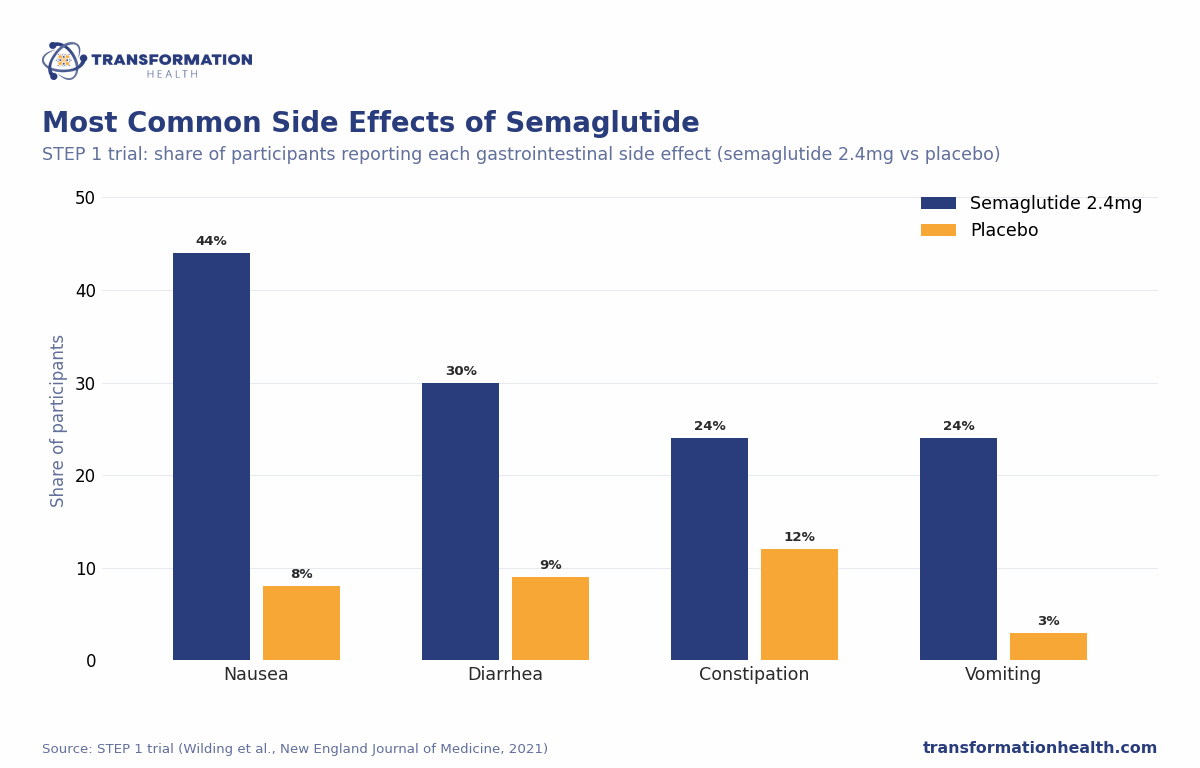
These side effects affect more than 10% of patients in clinical trials of GLP-1 medications and are considered an expected part of early treatment.
Embed this chart on your site (free)
Copy this code. It credits Transformation Health with a link back to this page.
Nausea
Nausea is the most commonly reported side effect. According to FDA prescribing information, nausea was reported in approximately 44% of patients on semaglutide for weight management compared to 16% on placebo. Tirzepatide trials showed nausea in roughly 25-31% of patients at standard doses. In both cases, most nausea was mild to moderate.
The nausea pattern is predictable. It tends to peak in the first 1-4 weeks of each dose escalation and then improve as your body adjusts. It often returns, more mildly, with each subsequent dose increase.
What helps:
- Eat smaller meals and stop before you feel full, not just satisfied
- Avoid high-fat meals, fried foods, and very spicy foods, especially early in treatment
- Eat slowly and chew thoroughly
- Stay well hydrated, but sip rather than gulp
- Bland foods (crackers, toast, plain rice) tend to sit better when nausea peaks
- Taking your injection in the evening so peak nausea occurs while you’re asleep can help some patients
Decreased appetite
This is both the intended mechanism and a commonly reported experience. Appetite reduction is significant for most patients and can be dramatic for some. The reduction in “food noise” (the constant mental preoccupation with eating) is something many patients describe as the most meaningful change they experience.
This effect is generally desirable, but it’s worth noting that it can reduce intake enough that getting adequate protein and nutrients requires intentional effort. More on this in the diet and lifestyle guide.
Vomiting
Vomiting affects a smaller proportion of patients than nausea but is more disruptive when it occurs. It tends to follow the same pattern – most common in the early weeks of each dose increase, then improving.
If vomiting is frequent enough to prevent you from keeping food or water down, contact your provider. Persistent vomiting can lead to dehydration and may warrant dose adjustment or temporary pause in escalation.
Diarrhea
GLP-1 medications alter gut motility, and for some patients this produces loose stools or diarrhea rather than (or in addition to) constipation. Both outcomes reflect the medication’s effect on how quickly contents move through the GI tract.
Staying hydrated is important if diarrhea occurs. If it persists beyond a few weeks, discuss it with your provider. Read the detailed guide: GLP-1 Diarrhea: Causes and Management.
Constipation
Paradoxically, slowed gastric emptying can cause constipation rather than diarrhea. Constipation is the more common of the two GI effects across the overall patient population.
Increasing fiber intake, drinking more water, and staying physically active all help. Osmotic laxatives (like MiraLAX) are considered safe for use alongside GLP-1 medications, but confirm with your provider before starting. Read more: GLP-1 Constipation: Why It Happens.
Less common side effects
These occur in a smaller percentage of patients but are worth knowing about.
Injection site reactions
Redness, itching, bruising, or mild swelling at the injection site can occur with any injectable medication. These reactions are usually mild and resolve on their own. Rotating injection sites each week (abdomen, thigh, upper arm) reduces the risk of localized tissue reaction.
For detailed injection technique guidance, see the GLP-1 Injection Guide.
Fatigue
Some patients experience mild fatigue, particularly during the early weeks of treatment or following dose increases. This is often related to reduced calorie intake rather than a direct drug effect. Ensuring adequate protein intake (60-80g daily) and not cutting calories more aggressively than the medication already is doing helps maintain energy levels.
Dizziness
Dizziness can occur, particularly if standing up quickly, and may relate to blood pressure changes that can accompany weight loss. Staying hydrated and standing up slowly helps. Persistent dizziness warrants a check-in with your provider.
Sulfur burps
A subset of patients report sulfur-smelling belching, sometimes called “egg burps.” This appears to relate to delayed gastric emptying causing fermentation in the stomach. It tends to improve as the body adjusts. Read more: GLP-1 Sulfur Burps: Why They Happen.
How long do side effects last?
The short answer: most common side effects follow a predictable arc.
They typically peak in weeks 1-4 of each new dose level, improve as the body adapts, and return briefly with the next dose increase before improving again. Most patients find that by months 2-3, GI side effects are minimal or absent at their stable dose.
The longer answer with more detail is in the dedicated guide: How Long Do Semaglutide Side Effects Last.
Rare but serious risks
These are rare. But they are real, they are disclosed in the prescribing information and FDA-approved labeling for branded versions of these medications, and you deserve an honest explanation of each.
Pancreatitis
Acute pancreatitis has been reported in patients taking GLP-1 medications. The overall incidence appears low based on available data, but pancreatitis is a serious condition that requires immediate medical attention.
Symptoms to watch for: sudden, severe pain in the upper abdomen (sometimes radiating to the back), nausea, and vomiting. If you experience severe abdominal pain that does not resolve within a short time, seek medical care immediately and contact your provider.
Patients with a history of pancreatitis should discuss this with their provider before starting GLP-1 treatment. Read the full discussion: GLP-1 and Pancreatitis Risk.
Gallbladder disease
GLP-1 medications are associated with an increased risk of gallbladder problems, including gallstones (cholelithiasis) and gallbladder inflammation (cholecystitis). This risk is thought to be partly related to the significant weight loss these medications can produce – substantial weight loss of any cause is a known risk factor for gallstone formation, because the body excretes more cholesterol through bile during active fat loss.
If you experience pain in the upper right abdomen, fever, nausea following fatty meals, or jaundice, contact your provider and seek medical evaluation. Read more: GLP-1 and Gallbladder Risk.
Thyroid C-cell tumors: understanding the boxed warning
GLP-1 medications carry an FDA boxed warning (the highest level of safety warning) regarding thyroid C-cell tumors. This warning is based on animal studies – rodents given GLP-1 medications at high doses developed a type of thyroid tumor called C-cell adenomas and carcinomas.
Important context: rodent thyroid tissue is more sensitive to GLP-1 stimulation than human thyroid tissue. Human epidemiological studies to date have not confirmed this risk, though it cannot be definitively ruled out in the absence of long-term human data.
Based on this theoretical risk, GLP-1 medications are generally contraindicated in patients who have a personal or family history of medullary thyroid carcinoma (MTC) or Multiple Endocrine Neoplasia type 2 (MEN 2). Your provider will screen for this history before prescribing.
For patients without these risk factors, the FDA has determined the benefits of these medications outweigh the theoretical thyroid risk. The full discussion: GLP-1 Thyroid Cancer Warning.
Kidney issues
GLP-1 medications can affect kidney function through multiple mechanisms, including dehydration from vomiting or diarrhea, and changes in blood pressure and blood flow. Patients with existing chronic kidney disease should discuss this with their provider. Interestingly, semaglutide has also shown kidney-protective effects in the FLOW trial (for patients with type 2 diabetes and CKD). Read more: GLP-1 and Kidney Health.
Gastroparesis
GLP-1 medications significantly slow gastric emptying, which is part of their mechanism of action. In some patients, particularly those with pre-existing gastroparesis (delayed stomach emptying), this effect can be severe. If you have a history of gastroparesis, discuss this with your provider before starting. Read the full guide: GLP-1 and Gastroparesis.
Allergic reactions
Serious allergic reactions, including anaphylaxis and angioedema, have been reported with GLP-1 medications. If you experience difficulty breathing, swelling of the face, lips, tongue, or throat, or a severe rash after taking your medication, seek emergency care (call 911). Discontinue use until you speak with your provider.
When to contact your provider
Contact your care team if you experience:
- Nausea severe enough that you cannot eat or drink
- Repeated vomiting over 24 hours
- Signs of dehydration (dizziness, very dark urine, dry mouth, rapid heartbeat)
- Severe abdominal pain
- Signs of an allergic reaction (rash, swelling, difficulty breathing)
- Vision changes
- Rapid or irregular heartbeat
- Jaundice (yellowing of skin or eyes)
- Any symptom that concerns you, even if it is not listed here
Go to the emergency room or call 911 for severe allergic reactions, difficulty breathing, or chest pain.
What about long-term side effects?
GLP-1 medications have been in clinical use for type 2 diabetes since 2005, with the weight-loss indications approved more recently. The long-term safety record for branded medications is building, though data on multi-year use for weight management specifically is still accumulating.
The FDA continues to monitor adverse event data through the FAERS (FDA Adverse Event Reporting System) database. Read more on what that data shows: GLP-1 Adverse Events: FAERS Data.
For a detailed review of what is currently known: GLP-1 Long-Term Side Effects.
Pregnancy and GLP-1 medications
GLP-1 medications should generally be discontinued before attempting pregnancy. Animal studies have shown potential fetal harm at high doses. If you are pregnant, planning to become pregnant, or breastfeeding, discuss this with your provider before starting or continuing treatment. Read more: GLP-1 and Pregnancy Safety.
If you’re having surgery or a procedure
The American Society of Anesthesiologists (ASA) issued guidance in 2023 recommending that patients on weekly GLP-1 medications hold their dose for one week before elective procedures requiring anesthesia. The concern is that delayed gastric emptying increases the risk of aspiration during anesthesia even when patients follow standard fasting guidelines.
Always inform your surgical team and anesthesiologist that you are on a GLP-1 medication. Read the full guide: GLP-1 and Surgery: When to Stop.
If you’ve already had surgery and are wondering when to restart: Resuming GLP-1 After Surgery.
All the topics in this section
- How Long Do Semaglutide Side Effects Last – EASY WIN, KD 0, 3.6K searches/month
- GLP-1 Nausea: What Research Shows
- GLP-1 Constipation: Why It Happens
- GLP-1 Diarrhea: Causes and Management
- GLP-1 Sulfur Burps: Why They Happen
- GLP-1 and Pancreatitis Risk
- GLP-1 Thyroid Cancer Warning
- GLP-1 Long-Term Side Effects
- GLP-1 and Gallbladder Risk
- GLP-1 and Gastroparesis
- GLP-1 and Pregnancy Safety
- GLP-1 Adverse Events: FAERS Data
- GLP-1 and Surgery: When to Stop
- Resuming GLP-1 After Surgery
Back to the GLP-1 Patient Guide.
Important: Compounded medications are not FDA-approved products. They are prepared by US-based, state-licensed compounding pharmacies and have not been independently evaluated by the FDA for safety, efficacy, or quality. All prescriptions require evaluation by an independent, licensed healthcare provider. Not all patients will qualify. Results vary by individual.